Saturday, October 14, 2023

Clement of Rome's Prayer For All Kind of Needs (1 Clement)


 From Early Christian Prayers, edited by A. Hamman, O.F. M. (1961)


May he who created everything keep the number of his chosen people, throughout the world, up to the strength he fixed for them through his dear Child, Jesus Christ. Through him he called us from darkness to light, from ignorance to knowledge of the glory of his name. We have confidence in you: you were at the beginning of creation; you have opened our inward eyes to give us knowledge of you, who alone are the Most High, in highest heaven, the Holy One, at ease among the holy.


You curb the arrogance of the proud, frustrate the designs of the Gentiles, lift up the modest and bring the mighty down, give riches and poverty, death and life. You alone watch over the interests of spiritual beings, you are the God of all flesh. You gaze into the depths you watch what men are doing. You are our help in danger, you save the despairing, Creator and Keeper of all that is spiritual. You give increase to the peoples of the earth, and from them all you chose us out to love you, through Jesus Christ, your dear Child, who brought us instruction, holiness and honour.


We beg you, Lord, to help and defend us. Deliver the oppressed, pity the insignificant, raise the fallen, show yourself to the needy, heal the sick, bring back those of your people who have gone astray, feed the hungry, lift up the weak, take off the prisoners’ chains. May every nation come to know that you alone are God, that Jesus Christ is your Child, that we are your people, the sheep that you pasture.


You have shown by what you have made and done how the world has been planned from eternity. The earth is your creation, Lord, yours that are true to every generation, just when you judge, your strength and splendour a marvel. Such competence yours in creating, such skill in setting firm the things you make, your goodness apparent in this world to see. You are loyal to those who trust you, merciful, compassionate. Forgive us our sins, our injustice, Our falls, our jarring deeds.


Do not count every one of your servants’ sins, but cleanse us with the cleanness of your truth and guide our steps in…inward holiness, that so we may do what is just and pleasing’ to you and to our rulers. Let us see your face, sovereign Master, and we shall peacefully pursue what is good, protected by your strong hand, kept from all sin by your mighty arm, preserved from those who hate us without cause. Give concord and peace to us and to all living on the earth, as you gave them to our fathers when they prayed to you, believing truly, ready to obey the All Powerful, the All Holy.


To those who rule and lead us on the earth you, sovereign Master, have given their authority and kingship —so marvellous that power of yours words fail to express— that seeing the glory and honour you have provided for them, we should be subject to their rule, not resisting your will. Grant them, Lord, the health, peace, concord and stability to use aright the sovereignty you have bestowed on them. For you, King of heaven, Lord of the ages, you it is that give to mortal men glory, honour and power over what is on the earth. Lord, make their counsels conform to what is good and pleasing to you, that using with reverence, peacefully, gently, the power you have given them, that they may find favour with you.


You alone have the means to do this for us, this and more than this. We thank you for it through Jesus Christ, the High Priest, our souls’ Protector. Glory and splendor be yours through him, now at this moment, in every generation, age after age. Amen.

Sunday, October 1, 2023

Why Protestants Should Talk About Mary


     Mary, the mother of Jesus, has been the topic of discussion among the debates between Protestants and Roman Catholics for quite some time. We have seen everything from the debate on the Marian Dogmas to the Theotokos accusations supposedly leading to "idolatry." I think that while Roman Catholics and even the Eastern Orthodox get her wrong at times, they do write a good bit on and teach some beneficial things about Mary that honestly we Protestants need to start talking about more. I will put forth the case that argues for the necessity of discussing Mary more and putting forth her importance in the church.

    The main thing to consider is her status as the mother of our Lord, Jesus Christ. She was the key prophecy for the introduction of the Messiah. Even going far back into Genesis when we read the following in Genesis 3:15 (in the NRSVue) regarding God's declaration to the serpent in the garden: "I will put enmity between you and the woman and between your offspring and hershe will strike your head, and you will strike his heel.” Irenaeus comments on this passage in Book V, Chapter 21 of Against Heresies where he says "from that time, He who should be born of a woman, [namely] from the Virgin, after the likeness of Adam, was preached as keeping watch for the head of the serpent." He also points to Galatians 3:19 which says "Why then the law? It was added because of transgressions, until the offspring would come to whom the promise had been made, and it was ordained through angels by a mediator." We should also note in the 4th verse of the next chapter, we read that "when the fullness of time had come, God sent his Son, born of a woman, born under the law." So we see that Jesus' prophecy of coming for salvation depends on Mary.

    With Mary's role highlighted and noted, we should also consider that somebody's view of her may also affect our Christology. For example, this is certainly the case for a heresy that seems to find it's way popping up among the protestants who do not seem to be comfortable with a certain title for Mary. This heresy is known as Nestorianism, which was known for rejecting the notion that Mary is the "Mother of God" or the Theotokos as it is known in the Greek language. This is reflected in people today refusing to call Mary the Mother of God, which seems strange since if Jesus is God, this follows with the logic of identity by saying Jesus is God, therefore Mary is the Mother of God. However, the rejection of this is because Nestorians essentially affirmed that within Jesus, there are two persons (the divine person and the human person) as opposed to the hypostatic union regarding the two natures. It was because of this, he believes Mary was only the mother of the human person and not the divine, which also lead to the fact that God or the divine part did not suffer for our sins, but rather it was only the human that suffered.

    It's very unfortunate that I have to see this among even some of the greatest bible teachers I have learned from. John MacArthur once said the following: "In fact, Roman Catholics refer to her as Theotokos, God-bearer. They say she gave birth to God and thus is to be elevated and adored. She gave birth to God. That is a terrible misconception. She gave birth to Jesus in his humanity. She did not give birth to God. God was never born." This is just blatantly false and goes contrary to proper biblical Christology regarding the Hypostatic Union where Jesus is both fully God and fully man. One of the twelve Anathemas against Nestorius at Ephesus was as follows: "If anyone will not confess that the Emmanuel is very God, and that therefore the Holy Virgin is the Mother of God (Θεοτόκος), inasmuch as in the flesh she bore the Word of God made flesh [as it is written, The Word was made flesh] let him be anathema." I am hoping MacArthur clarifies and repents of the statement, lest he fall into heresy that existed before Roman Catholicism did.

    One subject I might as well get out of the way is the Hail Mary. The Hail Mary is biblical and does not need to be something people get to worried about.  At least, partly it is. What are the words exactly, to those new to this subject? It goes "Hail, Mary, full of grace, the Lord is with thee. Blessed art thou amongst women and blessed is the fruit of thy womb, Jesus. Holy Mary, Mother of God, pray for us sinners, now and at the hour of our death. Amen." The bold letters are the part that I would argue is the biblical part and is what I mostly say instead of asking Mary to pray for us. The first half of the first part of the prayer is found in Luke 1:28 while the second half is in Luke 1:41-42. The second half of the prayer that isn't in bold letters comes from a codified addition to the prayer via the Council of Trent and it's catechism. Why pray this prayer? First, I would argue that it is a meditation that is scriptural and therefore, beneficial to sanctify us. Secondly, I would say that it helps to reflect on the incarnation of our Lord, whom is blessed and divine.

    Furthermore, Martin Luther would seem to advocate for the Hail Mary pre-Trent. We read the following in Luther's Personal Prayer Book: "Our prayer should include the Mother of God... What the Hail Mary says is that all glory should be given to God, using these words: "Hail Mary, full of grace. The Lord is with thee; blessed art thou among women and blessed is the fruit of thy womb, Jesus Christ. Amen!" You see that these words are not concerned with prayer but purely with giving praise and honor...We can use the Hail Mary as a meditation in which we recite what grace God has given her. Second, we should add a wish that everyone may know and respect her... He who has no faith is advised to refrain from saying the Hail Mary." So if the one who helped start the Protestant Reformation and was against Roman Catholic dogmas decided to affirm praying this prayer, then it shows that it is perfectly fine to pray as a Protestant.

    We also must consider the relevance of Mary in the biblical text. In the Episcopal Dictionary of the Church, we read the following on Mary regarding the events she was involved in with the New Testament: "her betrothal to Joseph; the annunciation by the angel that she would be the mother of the Messiah; her visit to Elizabeth, the mother of John the Baptist; the birth of Jesus; the visits of the shepherds and the wise men; the presentation of Jesus in the temple; the flight into Egypt; the visit to Jerusalem when Jesus was twelve years old; the wedding at Cana; an occasion when Mary and Jesus' brothers asked to speak to him while he was speaking to the people; the crucifixion when Jesus commended her to John; and the meeting with the apostles in the upper room after the Ascension." So not only was she there for the beginning of his life, but also the beginning of what came after his death and resurrection. She was there for the beginning of the Church with the event of the conversion of the three thousand.

    Furthermore, there are three major feast days of the apostolic and catholic church over the years related to Mary known as Feast of Mary, The Mother of our Lord Jesus Christ (August 15), The Annunciation (March 25), and The Visitation (May 31). With these days of honor and remembering her, we must consider the lessons noted. We pray collects on these days in reflection of these. On The Feast of Mary, we pray for God to grant "that we, who have been redeemed by his blood, may share with her the glory of thine eternal kingdom." On the Aunnunciation, we ask for him to "pour thy grace into our hearts; that we who have known the incarnation of thy Son Jesus Christ, announced by an angel to the Virgin Mary, may by his cross and passion be brought unto the glory of his resurrection." On the Visitation, we pray for him to grant "us who honor the exaltation of her lowliness to follow the example of her devotion to thy will; through the same Jesus Christ our Lord, who liveth and reigneth with thee and the Holy Spirit, one God, for ever and ever.

    Mary was not just an average person, but was chosen by God to give birth to the Messiah, Jesus Christ. Our Savior was in the womb of Mary and when he was born, he fulfilled prophecies foretold in scripture. This happened to a woman who wasn't a rich princess ruling over a land or some powerful warrior, but a humble woman who eventually not only gave birth to Jesus, but also raised Him during his life on earth for the ministry that was soon to come. We should pray and meditate about Mary so that we can strive to be like her in the faith she had for God and the way of living she lead as a saint in the church of our Lord. May we strive to have her character, as well as the same grace she received by the time we are reunited in heaven with the saints. Amen.

Saturday, September 16, 2023

Made In The Image of God: Neither Toxic or Woke

     We hear the debate come up often on an interesting subject relating to anthropology: what is a man or a woman? Some will say it is based on what kind of chromosomes you have and that alone determines it. Others will say it depends on physical characteristics (such as a beard for men and long hair for women). Some will say that is simply based on how one feels and thus how they choose to identify themselves. I think we need to really take two steps back and re-examine this issue much more carefully because this debate has caused some to really start to view it black and white to the point that they will even accuse women who are just really strong as being "trans" despite them never claiming to be such. I think it's time we looked at this biblically from a Christian perspective. Also, all bible verses from here will use the NRSV Updated Edition.

    We read the following in Genesis 1:26-27: "Then God said, “Let us make humans in our image, according to our likeness, and let them have dominion over the fish of the sea and over the birds of the air and over the cattle and over all the wild animals of the earth and over every creeping thing that creeps upon the earth.” So God created humans in his image, in the image of God he created them; male and female he created them." We do not see much assigned here to the text regarding the purpose of male and female in terms of role and design other than both will have dominion over the rest of creation equally. Then we read in Genesis 2:21-22 the following: "So the Lord God caused a deep sleep to fall upon the man, and he slept; then he took one of his ribs and closed up its place with flesh. And the rib that the Lord God had taken from the man he made into a woman and brought her to the man." The passage here is interesting especially based on some wisdom of this verse from Matthew Henry's commentary when he says that "the woman was made of a rib out of the side of Adam; not made out of his head to rule over him, nor out of his feet to be trampled upon by him, but out of his side to be equal with him, under his arm to be protected, and near his heart to be beloved."

    Suggesting this so far, we see at least an equality yet distinction in the notion of man and woman via the origins of Adam and Eve. However we should consider the qualities of both man and woman in this scenario. Starting with men, we shall point out some good key qualities. We know they must be self-controlled in all things, models of good works, offering integrity, and have sound speech that cannot be censured (Titus 2:6-7). We also see that husbands in particular should love their wives like Christ loved the church (which means they are willing to sacrifice their life for them) and to love them as they would love themselves (Ephesians 5:25-29). Women are modeled in a similar manner with the commands to "be reverent in behavior, not to be slanderers or enslaved to much wine; they are to teach what is good, so that they may encourage the young women to love their husbands, to love their children, to be self-controlled, chaste, good managers of the household, kind, submissive to their husbands, so that the word of God may not be discredited" as Titus 2:3-6 teaches. Elsewhere we read that women who are married must be submissive to their husbands (Ephesians 2:22-24). 

    With all this in mind, how then are we understand and approach the subject of what it means to be a man or a woman? I think that biological factors such as being created in the beginning as such would determine that. However, this needs to be considered in light of the other debate regarding those who identify as non-binary (a subject I shall eventually seek to write about in the future). Until then, we must go over a few subject matters of very popular and sometimes controversial opinions regarding the status of men and women in today's culture. We will then explore if each idea contains biblical support of it is the result of outside ideas. We shall begin with a very popular one and probably a tough one to address.

    Men having beards is quite common around. Some will suggest a man without a beard is no true man at all. While indeed their is early church father support for this sort of idea, we must address if it's biblical or merely cultural to hold this view of beards as primary ontology for men. The main area for this we see is found in Leviticus with laws telling us men to not shave the edges of our beards (Leviticus 19:27 & 21:5). However, to keep this in mind, we are not under the law of Moses as the work of Christ and the covenant we are under puts us under a different one. However, a beard can help with a distinguishing factor. I myself have a beard and do not mind it as I view it as a way to honor the Lord in growing it. However, I do not see how trying to make it a mandate is something we must do especially if a man cannot grow a beard in certain cases. If a man wants to force the idea that mandates being a Christian or a man by having a beard, then they have become a new Pharisee as a result and are adding to the teachings of Christ as a result (2 John 9-11).

    Another idea is the idea of masculinity in men in today's culture is to like several things such as sports and not to like certain things outside of the cultural norm such as writing poetry or watching anime. The main problem I have with this is that it presupposes modern cultural ideas into the biblical idea in a conforming way. Romans 12:2 teaches us clearly that we should "not be conformed to this age, but be transformed by the renewing of the mind, so that you may discern what is the will of God—what is good and acceptable and perfect." If we are going to be godly people, we should not conform to the world as the ultimate standard of things as the means to determine what a man is, but instead, we should strive to utilize what is in our culture while applying Christian principles. Especially as it relates to sports for example, Tertullian addresses Christian interests in watching plays and sports in the Greco-Roman world, condemning them. So not only does he condemn the play acting (which some would say isn't a manly activity), but he also condemns the manly sport of arena fighting, which the popularity of in that time could be compared to football today. So the idea of a man liking certain modern cultural things isn't something we should view as mandatory.

    One case for both is the idea of the hair style, suggesting men need short hair while women need longer hair. First off, this notion found in the Old Testament law no longer applies to us Christians due to the covenantal nature of the law and thus, the new covenant having it's own laws. The other case some try to argue is via 1 Corinthians 11, where it says a women's hair is a covering for the honor of God in verse 15. Dr. Michael Heiser notes something interesting in a February 7, 2015 episode of the Naked Bible Podcast. Essentially, the women's hair was viewed as a covering because it was essentially the same way men cover up their crotch. Back then, the woman's hair as a cover (peribolain in the greek) was essentially a genital similar to the male's testicles. There is even a good dialogue in the scholarly world on this subject between Troy W. Martin and Mark S. Goodacre regarding the subject of this interpretation in 1 Corinthians 11. This certainly would make sense especially given the roman medical texts and the Greek word used. So that is why the idea of the long hair being condemned is there because it essentially is not rooted in gender roles, but the understanding that the Greco-Roman world viewed women's long hair as a female genital and it was best to cover it up with a head covering (veil or scarf), unless you wanted to be guilty of public indecency in the church in the Greco-Roman world.

    I have made plenty of addressing towards the more toxic approaches to the idea of gender at the moment, but I think it is time where I poke at the other negative side of the debate. The woke nemesis! In all seriousness, while I can agree with some things taught by the more progressive view, I also agree with some conservative views. My critiques are aimed at what I find to eventually become problematic and even hypocritical issues regarding the discussion of gender, sexuality and being. In fact, it is these ideas I plan to refute which I see harm several friends of mine who are struggling with their gender identity and expression because of the things society demands out of us. So I will plan to deal with each part accordingly. Starting first, with the ideas of the context of masculine and feminine values in the midst of the transgender population.

    Going forth on this, we should be careful to consider the refutations of certain claims earlier and understand why it may seem that those who are transgender or struggle with some form of dysphoria end up getting confused or even misled by certain ideas. For example, take the situation of somebody we will call Sally for now, who eventually encounters a case of gender dysphoria which leads her to struggle with being referred to as female and instead feels more masculine and would prefer to be identified as a male. Before we engage in this further, we need to address questions about again the issue of what it means to be of any gender. While sex and gender are two different aspects, confusions about the two can be considered and to address whenever an expression ends up being as toxic as the straight man who comes under fire.

    Let's consider the example of Sally going to become Sal with using he/him pronouns now. How does Sally wish to express themselves as a male regarding their gender identity? Is it by having short hair and wearing more muscular attire to go with trying to earn more muscle? There is nothing wrong with simply trying to figure it out, but the problem arises when this is performed as it says "this is what it means to become a man." When we make that the point based on dressing up in a certain way that is considered toxic when cis men do it, then it ultimately ends up either as hypocrisy or as a means to think therefore that there are permissions to become toxic among certain transgender individuals. It is seen as an issue I would find because then what somebody may consider to be what defines a man differs from the cis ally or another person struggling with identity and yet they go the more effeminate male route instead. It becomes a wrestling again over the identity of what it means ontologically to be a "man" that borders on adopting toxic traits in order to feel complete and diffuse the dysphoria.

    Instead, we could just easily explain that the situation is revolved by saying that they can be female and yet feel like they can have short hair and be more masculine. However, this will not work in all cases of course, considering the real issue of gender dysphoria as a psychological problem that can bring about mental and eventually physical harm through even potential death by self. I get concerned about this because I have friends who while sometimes being comfortable with their new identity at times, I feel like public and peer perception as well as influence from both the opponents and supporters can tend to lead to more confusion and thus trigger a dysphoria episode that brings on depression like crazy. We should be interested in reducing these cases and addressing this matter gently with respect.

    My solution to this aspect is simple: we must do our best to avoid treating certain elements of masculinity/maleness and femineity/femaleness as toxic in which these same traits may possibly be found in certain areas of masculinity and femineity among the transgender population. With that, it helps us to look past this being the issue and seek for a more philosophical and theological aspect towards what it means to be a man or woman. Many may say the chromosomes and DNA determine this, but that would of course determine sex and the basis of male or female. Anything added "masculine/strong" or "effeminate/soft" are areas which are outside of the issue of genetics in gender.

    Thus I wish to leave forth this article so that those may wish to interact with the subject and eventually help come up with an answer to the question of what does it truly mean to be a man or woman? We must avoid the toxic and liberal aspects of it that are taught nowadays because they both miss biblical and fundamental elements. Which means we should approach the subject of gender, identity and transgender people from a perspective that seeks to be objective and balanced. If we don't, then not only do we end up muddying the waters and never get to the end or solution to this debate, but we do so at the cost of the mental health, value and dignity of everybody who either is uncomfortable with themselves or struggles with some form of gender dysphoria. This question being dealt with not only will help us be united in an understanding of being male/female ontologically, but it will also help us to reduce the amount of deaths and depression episodes that occur because of these questions being unanswered and thus become added stress/confusion for the individual.

Tuesday, September 5, 2023

A Triperspectival Approach to the Canon

     The canon of scripture has been a highly contested and debated subject among the Protestants, Roman Catholics and Eastern Orthodox Christians in history. We should always be very careful when we discuss the subject of the biblical canon because it is very easy for people in all three parties to say something contradictory or inconsistent about how the canon is decided. However, I would like to propose a Triperspectival approach to the canon, which I have argued and defended in a few discussions and debates regarding the canon. It is a protestant approach, but it considers the tradition of the early church as well.

    When we discuss this topic, I feel it should be important to note that any quotes from Dr. Michael J. Kruger will come from this article, which is from Chapter 3 of his book "Canon Revisited: Establishing the Origins and Authority of the New Testament Books." I shall base it off this model since Kruger is a student of John Frame, the theologian who formulated the Triperspectival model approach, and it's easy to see this present in his writing for the argument for a self-authenticating model of the canon of scripture. While Dr. Kruger applied this to the New Testament in his book, I will work to apply this also to the Old Testament as well when also engaging with the discussion of the apocrypha.

    Let us start with establishing the three perspectives and their assigned points as Michael Kruger lays out for us: "There are three attributes of canonicity: (1) divine qualities (canonical books bear the “marks” of divinity), (2) corporate reception (canonical books are recognized by the church as a whole), and (3) apostolic origins (canonical books are the result of the redemptive-historical activity of the apostles)." Divine qualities will act as the normative perspective, apostolic origins will act as the situational perspective, and corporate reception will act as the existential perspective. Let us expound on how each one helps and how therefore it helps further the use of verifying which books belong in the bible and fit this model.

    Divine qualities as a normative perspective is "that it bears the divine qualities or divine character of a book from God." We would affirm that Scripture is the standard that sets itself for being considered divine scripture, especially in light of 2 Timothy 3:16-17. However, the question is how can this be considered a proof? Wouldn't this be considered circular reasoning? Yes, but not any bad kind. Consider Dr. Kruger's words on this: "This sort of circularity is not a problem but simply part of how foundational authorities are authenticated. For instance, let us imagine that we want to determine whether sense perception is a reliable source of belief. If I see a cup on the table, how do I know my sense perception is accurate? How would I test such a thing? I could examine the cup and table more closely to make sure they are what they seem to be (hold them, touch them, etc.). I could also ask a friend to tell me whether he sees a cup on the table. But in all these instances I am still assuming the reliability of my sense perception (or my friend’s) even as I examine the reliability of my sense perception. Or, as another example, let us imagine that we wanted to inquire into whether our rational faculties would reliably produce true beliefs. How could we examine the evidence for the reliability of our rational faculties without, at the same time, actually using our rational faculties (and thereby presupposing their reliability)?"

    Another point to this is in William Alston's quote from page 41 of his essay, "The Knowledge of God" in the book "Faith, Reason, and Skepticism," that says that there "is no escape from epistemic circularity in the assessment of our fundamental sources of belief." So with this in mind, we see that scripture in order to be divinely inspired, it must bear divine qualities in it. According to Kruger, "These “marks” (or indicia) can include a variety of things, but traditionally include the Scripture’s beauty, efficacy, and harmony..." So it must be affirmed that this question of canon being self-authenticating is something only Christians can test regarding the authority of canon. Especially in light of John 10:27 saying "My sheep hear my voice, and I know them, and they follow me." In other words, as Kruger tells us, "... canonical books are received by those who have the Holy Spirit in them. When people’s eyes are opened, they are struck by the divine qualities of Scripture—its beauty, harmony, efficacy—and recognize and embrace Scripture for what it is, the word of God. They realize that the voice of Scripture is the voice of the Shepherd." So in order to begin with affirming scripture as divinely inspired and self-authenticating, we must at least begin with the presupposition that the text is inspired or divine.

    Prophetic or Apostolic origins leads us to understand the a book that is divinely inspired and part of the canon, must be written by an inspired prophet/apostle of God or at least by an associate of the prophet/apostle. This deals with the facts and history of the composition of each of the relevant books at this point for a situational perspective. It would make sense that if we have an author of the book writing something part of the divinely inspired canon, the books themselves would have to be written by a divinely inspired prophet/apostle or an associate of one. This can be observed easily and scholars have noted that the potential authors of the books are either written by a prophet/apostle or at least an associate like a scribe or friend.

    Some may say the associate might not be a prophet and therefore is not inspired. Dr. Kruger addresses this: "Apostolic origins were also central to early discussions about potential canonical books; for example, the Muratorian fragment rejected the so-called Pauline epistle to the Laodiceans because it was not really written by Paul. The church fathers understood a book as having apostolic origins even if it was not directly written by an apostle but nevertheless bore apostolic content and derived from the foundational period of the church. It is for this reason that Tertullian regarded Mark and Luke as “apostolic men.” So while Mark wrote his Gospel, he received the info from Peter and was an associate of other apostles. Luke wrote his gospel and was an associate of Paul as well as he gathered his info from others as well. The same can be said for the Old Testament authors.

    Corporate Reception is an existential perspective which focuses on the existential aspect of the covenant people. Dr Kruger notes regarding that "when God, by his redemptive activity, creates a covenant community, he then gives them covenant documents that testify to that redemption. For these reasons, Meredith Kline and others have argued that canonical books are ultimately, and primarily, covenantal books. The biblical witness indicates that it is God’s corporate people—not as individuals but as a covenant whole—who are “entrusted with the oracles of God” (Rom. 3:2). As Kline has argued, God gives the covenant documents with the intent that those documents become a “community rule.”" We see this then cites Romans 3:2 which refers to the Jews being given complete trust over the Old Testament, which also then puts them in charge of their canon. Then the New Covenant comes and the Christian Church provides the right to create their own New Testament canon in reception based on books they received.

    Some might object to say "what about the church councils which declare the canon of scripture to include apocrypha/deuterocanonical books?" My response would be that this doesn't apply and shouldn't because those apocrypha books fail to become part of the covenant documents since they weren't written for us. Most of those books would've at least been given to the Jews and we know from research that the Jews did not even consider or accept any of those books as part of the corporate reception. Some might then add about other Jewish sects and their canons, to which I argue that while some might have only the first five books of the Bible as part of the canon and others the Protestant canon of the Old Testament, we still have those books and not one declaring the books of the apocrypha to be canonical in any sense of the word. If some dare to say "who cares what the Jews say, they killed Jesus." This fails to account Jesus was a jew as well and also shows ignorance and antisemitism on their part since the Old Testament was written by Jewish authors as well as were the first members of the Christian Church in the first century.

    While I argue for the three perspectives in the model formulated from Frame's Triperspectivalism, Kruger uses different definitions for his, but capture the same thought: "If one looks at the canon from the perspective of corporate reception, then canon is most naturally defined as the books received and recognized by the consensus of the church (exclusive). If one looks at the canon from the perspective of divine qualities, then canon is most naturally defined as those books that are used as authoritative revelation by a community (functional). And if one looks at the canon from the perspective of apostolic origins, then the canon is most naturally defined as those books given by God as the redemptive-historical deposit (ontological). The self-authenticating model, then, accommodates all three definitions of canon and acknowledges that each of them has appropriate applications and uses."

    Not only do these three get used, they interact. The normative perspective of the divine qualities is verified by the corporate or covenant community that received them and how they recognized the scriptures to be divinely inspired while also the apostles themselves verified it through the Spirit that inspired them to write those divine words. The situational perspective of the prophetic/apostolic origins were verified by the divinely inspired contents of the revelation they receive from God and that they write down as well as the recognition of each prophet or apostle being such by their particular covenant community at that particular time. The existential perspective of the corporate reception of the covenantal community is verified by the divinely inspired content which addresses even the individuals being under the covenant for the documents which also lay out their responsibility for the community and the prophet/apostle belonging in that community helps further establish that connection for their corporate reception and judgement therefore of the books.

    While the model can certainly be shaped and sharpened more, I feel like this is a good enough model to argue for the Protestant canon because the test requires all three perspectives being verified and while a book of the apocrypha or New Testament apocryphal works might pass one or two of the perspectives, it cannot pass all three and because of that, it will not be sufficient. According to the model, it must have all three perspectives and all three must interact and self-authenticate each other. If they fail to do so, then this renders the canonical status of that particular book to be doubtful and questionable. Hopefully this article sparks up more conversations about the subject of the biblical canon in such a way that it leads to more fruitful and edifying debates.

Wednesday, August 23, 2023

Christianity Is A Religion (Why This Is Good & Biblical)


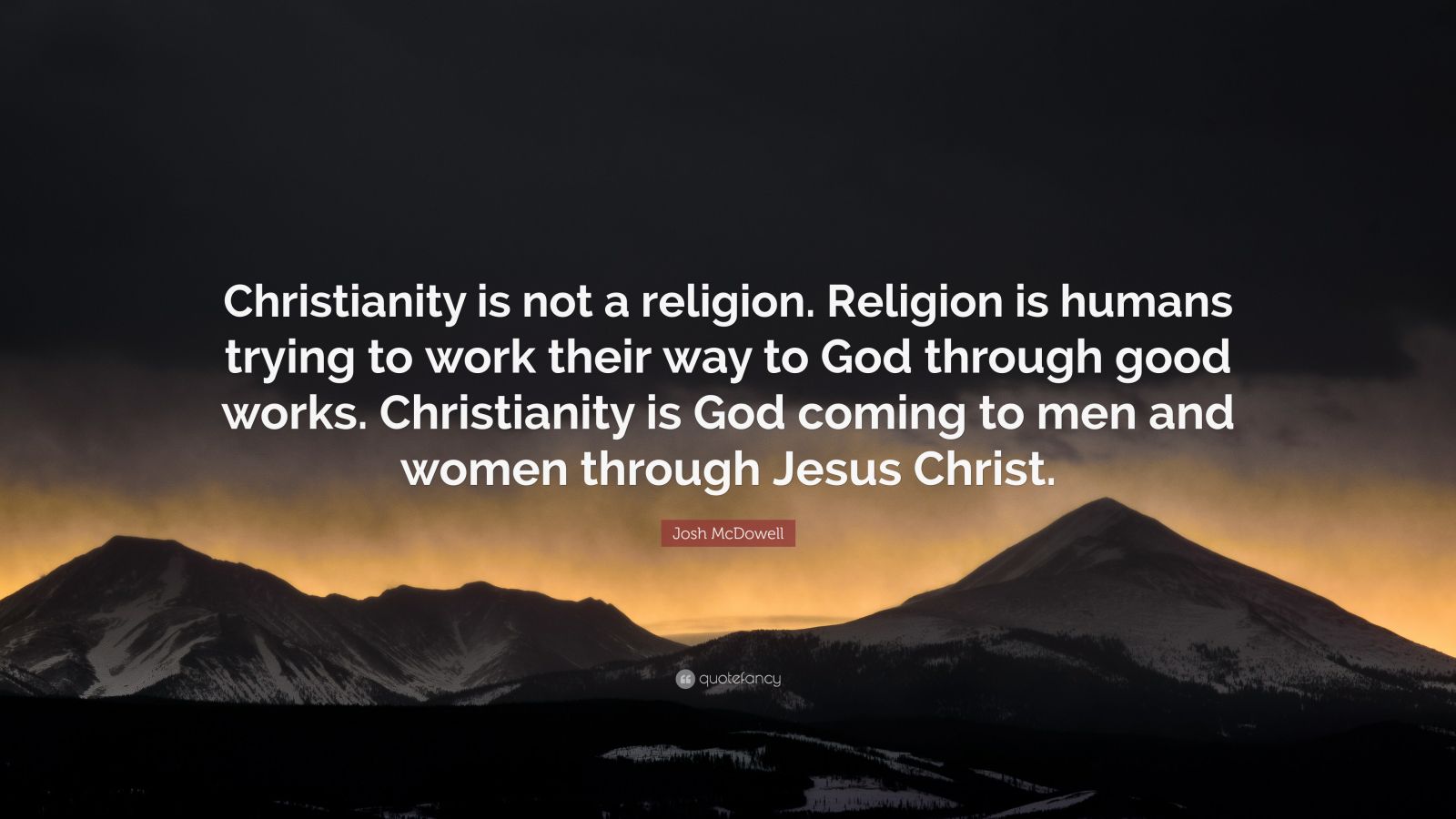
     We have heard the statements before that go "Christianity is not a religion. It is a relationship." I am not sure where it begins, but it does appear that Josh McDowell has said it once in his book, "More Than A Carpenter." However, I think more people have gotten this idea from a few pastors as well as especially a popular viral video on YouTube that was released on January 10, 2012 entitled Why I Hate Religion, But Love Jesus. I myself was even influenced by this video as it sparked my flame even more in 2014 when I was attending college as a young Christian. I even picked up and read the book version entitled "Jesus Greater Than Religion." While I agree with the sympathy of trying to call out corrupt practices in certain churches, I think it is unbiblical and even unchristian like to say that Christianity is not a religion and that religion is bad. I will address various objections to religion after I address the one key bible verse that refutes this notion.

    Let's begin with scripture. Quoting from the KJV, we read the following in verses 26-27: "If any man among you seem to be religious, and bridleth not his tongue, but deceiveth his own heart, this man's religion is vainPure religion and undefiled before God and the Father is this, To visit the fatherless and widows in their affliction, and to keep himself unspotted from the world." So we see clearly a negative description of religion, only to then be followed with a positive description of religion as something "pure" and "undefiled before God." Scripture clearly lays out that there is a religion God hates, but there's also a religion God loves. If you would suggest that Christians visit the fatherless and widows in their affliction, and to keep themselves unspotted from the world, then you have described Christians practicing religion that is pure. So scripturally speaking, in plain words, Christianity has to be a religion on the basis of what it teaches and what Christians thereby practice.

    Some will probably then say all kinds of thing of what religion is, but define it in ways that do not fit the definition. Let's go over the definitions. Merriam-Webster defines it as "a personal set or institutionalized system of religious attitudes, beliefs, and practices." Sounds like Christianity regarding beliefs and practices we have. Oxford Learner's Dictionaries defines it as "the belief in the existence of a god or gods, and the activities that are connected with the worship of them, or in the teachings of a spiritual leader." Once again, sounds like Christianity. We believe God exists, we worship God and we affirm the teachings of our spiritual leader, Jesus Christ. I am sure you can try to find any other dictionary online or in book form and you will find various different definitions, most of which will agree with the ideas relayed in these two.

    Some might then put forth the argument that "Christianity is not a religion because it does not believe in worship in the church and it is a relationship without having leaders in charge." The problem with this is that Matthew 16:18 is a clear passage where Jesus builds his church upon the rock. We also see that there is leadership explicitly commanded in 1 and 2 Timothy regarding presbyters, elders, deacons, etc. in the New Testament. It would be awkward for this objection to remain one unless of course one removes those two epistles from their bible. Furthermore, this also proposes problem for the historic faith since pretty early in the 1st and 2nd century, we see leadership in the church with bishops and deacons who are well known in the church.

    Another popular objection is that "Christianity is not a list of rules to follow." Essentially the idea is that faith alone is all that is needed and that we should not focus on what is sin and therefore not try to do good works at all. Apart from this being a repeat of the classic Antinomianism heresy, this objection fails in that ignores again the teachings of the Bible. Jesus teaches in several places in the bible that we need to repent (Luke 13:3-5, Matthew 3:2). The Apostles even teach this after the likeness of Jesus. Furthermore, this then ignores the commands and rules we are obligated to follow in the Sermon on the Mount as well as the verses that lay out sin (Mark 7:21-23, Galatians 5:19-21, 2 Timothy 3:1-5, 1 Corinthians 6:9-10). Plus there is the most damning of verses in 1 John 3:4 which reads: "Whosoever committeth sin transgresseth also the law: for sin is the transgression of the law." Then we read in verses 6, 8 and 9 the following: "Whosoever abideth in him sinneth not: whosoever sinneth hath not seen him, neither known him.... He that committeth sin is of the devil; for the devil sinneth from the beginning. For this purpose the Son of God was manifested, that he might destroy the works of the devil. Whosoever is born of God doth not commit sin; for his seed remaineth in him: and he cannot sin, because he is born of God." This does not negate Justification by Faith Alone, but even remember that Ephesians 2:8-9 isn't verses that are alone. Read the very next verse that teaches "For we are his workmanship, created in Christ Jesus unto good works, which God hath before ordained that we should walk in them."

    One other common objection is that "Religion is about rituals without meaning and Christianity is not about rituals." This is failed automatically by the two common sacraments shared with every Christian out there: Baptism and The Lord's Supper. Both of these sacraments are directly ordained for us to perform by the Lord. Before I show these, let's talk about one thing some may call a ritual: going to church every Sunday morning. Act 20:7 speaks clearly of the apostles gathering to break bread and fellowship on the first day of the week (Sunday). 1 Corinthians 16:1-2 goes further with "Now concerning the collection for the saints, as I have given order to the churches of Galatia, even so do yeUpon the first day of the week let every one of you lay by him in store, as God hath prospered him, that there be no gatherings when I come." Hebrews 10:25 even suggests not to forsake the gathering together of the Christians. However, we are about to get even more deeper with a focus on the subject of the Baptism and Lord's Supper.

    Baptism is ordained in Matthew 28:19 with the words: "Go ye therefore, and teach all nations, baptizing them in the name of the Father, and of the Son, and of the Holy Ghost." Christ commands us to baptize and even gives a formula for it. 1 Corinthians 12:12-13 also gives us a better understanding here. "For as the body is one, and hath many members, and all the members of that one body, being many, are one body: so also is Christ. For by one Spirit are we all baptized into one body, whether we be Jews or Gentiles, whether we be bond or free; and have been all made to drink into one Spirit." Furthermore, we see this is also baptism which "saves" us according to 1 Peter 3:20-21 in the context of discussing salvation via the work of Christ on the cross being similar to Noah in the ark: "Which sometime were disobedient, when once the longsuffering of God waited in the days of Noah, while the ark was a preparing, wherein few, that is, eight souls were saved by water.  The like figure whereunto even baptism doth also now save us (not the putting away of the filth of the flesh, but the answer of a good conscience toward God,) by the resurrection of Jesus Christ." Even in Acts 22:16 we read of the urgency for baptism saying "And now why tarriest thou? arise, and be baptized, and wash away thy sins, calling on the name of the Lord."

    The Lord's Supper is ordained by the following in Matthew 26:26-28 which reads "And as they were eating, Jesus took bread, and blessed it, and brake it, and gave it to the disciples, and said, Take, eat; this is my body. And he took the cup, and gave thanks, and gave it to them, saying, Drink ye all of it; For this is my blood of the new testament, which is shed for many for the remission of sins." Elsewhere, we read the same similar command on repeat in 1 Corinthians 11:23-25. Furthermore, there are even commands on how not to participate in this sacrament in verses 17-22 and 27-34 as well as considerations that must be taken when doing a form of self-examination before the eating of the bread and wine. If it is not a big deal, then why does this sacrament and baptism receive such lengthy treatment in sacred scripture regarding the practice?

    Another objection you will hear often is that "Religion is all about trying to work to earn God's favor and search for God." This and a few other similar objections are based on caricatures which have no proof for this regarding Christianity as a religion doing this. We simply do good works because as the scriptures says in James 2:26 so clearly: "For as the body without the spirit is dead, so faith without works is dead also." Furthermore, we don't seek after God. We all know God exists in some degree. Consider Romans 1:18-20 which reads that "the wrath of God is revealed from heaven against all ungodliness and unrighteousness of men, who hold the truth in unrighteousnessBecause that which may be known of God is manifest in them; for God hath shewed it unto them. For the invisible things of him from the creation of the world are clearly seen, being understood by the things that are made, even his eternal power and Godhead; so that they are without excuse." So we don't teach that we work to gain God's favor or to find him. We already are found by God and we found him, but we work as Christians in the religion to honor, praise and worship him. It is a sign of respect, submission and honor to God, which is commanded out of his covenant people in the church.

    To the one who thinks they shouldn't call Christianity a religion, I would advise you to really rethink of how you define religion. Christianity is a different religion from all the others. Instead of telling you to worship a God you cannot personally know or communicate to, Christianity is a religion where God is truly personal with you. Instead of doing works to earn and obtain salvation, Christianity is a religion which teaches you are justified by faith alone and works are what sanctify us after the fact as we obey what our God commands us to follow in our relationship. It is a religion in that we have our beliefs and practices centered around God and not centered around man. It is a pure and undefiled religion which we call Christianity and God honors this. Christianity is a religion and a good one. Amen.

Monday, August 14, 2023

A Triperspectival Approach to the Three-Legged Stool of Anglicanism

     The three-legged stool is a popular reference to the aspect in Anglicanism which refers to the supposed threefold sources of authority regarding doctrine and beliefs. These three sources are then said to be Scripture, Tradition & Reason. One supposed view of this comes from Richard Hooker in Book V (8.2) of his work entitled "Of The Laws of Ecclesiastical Polity": "What Scripture doth plainly deliver, to that the first place both of credit and obedience are due; the next whereunto, is what any man can necessarily conclude by force of Reason; after this, the voice of the church succeedeth. That which the Church by her ecclesiastical authority shall probably think and define to be true or good, must in congruity of reason overrule all other inferior judgements whatsoever." So while the stool analogy isn't used, this at least helps us see how it can be utilized.

    Some might however think there is a problem with this view. In an article from the July 26, 1998 article of The Living Church, we read the following from : "A sick paradigm has made its way into everyday Episcopal thinking. It comes pretending to be an ancient truth, but it's only a modern idea. It threatens some pillars of our Anglican and Episcopal identity. Maybe it even means to do so. I am referring to the spurious analogy of the "three-legged stool."... When tradition and reason (and "experience," for that matter) are elevated to be "complementary" to scripture, they, in fact, become competing standards. It's obviously that a Bible story cannot be equally "reasonable" and "miraculous." The definition of "miracle" involves something outside the grasp of human reason. When "reason" is raised to become an equal authority, the old test for truth (Is it scriptural?) is replaced by the new test: Is it reasonable?... "Tradition," as important as it is to Episcopalians, is another undeserving candidate to stand on equal footing with scripture... With the Episcopal Church more fractured than ever, this is no time to hide behind unhelpful paradigms. The hope for healing the church is in rediscovering our biblical foundation... As we humbly acknowledge the authority of God's word and seek to bend our lives to fit its message, he will show us his plan and lead us to the Savior. There is no hope for the sick paradigm of the three-legged stool, and no use hanging on to it."

    My goal with this article is to put forth a form of Triperspectivalism into the three legged stool and with the image shown above, we will approach this from the observation of Scripture as the Normative Perspective, Tradition as the Situational & Reason as the Existential. I will expound on why each falls under the individual perspective and thus why there will be the necessity of each being dependent on each other in order to prove that this approach of the three-legged stool theology can be utilized while still affirming a Sola Scriptura approach in our theology. All I need to demonstrate is that scripture can be considered the only ultimate source of authority for doctrine and practice while yet being able to affirm the validity of the other three authorities. Let us begin.
    Scripture as a normative perspective, just to remind people, tells us that scripture essentially sets the standards or norms in a given topic. So when it comes to our doctrinal beliefs and practices, we start with the perspective that scripture what ultimately sets the standard at this point. While we might rely on the other two perspectives as well, Scripture is shown it's necessity and ultimate place in this topic by becoming what we must go to in order to know what God demands/requires out of us via the divinely inspired scriptures. Yet we also have to apply this authority to the other two. Hence, we shall now begin our focus on the situational and existential.
    Tradition, as the situational perspective, becomes the focus of the "facts" or "historical data" in the world. When we observe tradition, we shouldn't blindly accept all traditions. Especially if they do not match up with scripture. It should be tradition that is compatible and therefore in uniformity with the scriptures. This is necessary especially for doctrine because we shouldn't expect to follow something of novelty in tradition. For example, the subject of Open Theism becomes a talking point and several proponents or advocates of it will admit that it's a brand new doctrine to be introduced into the church because of purely scripture only authority. The problem with this is in the fact that asking how come no early church father or early church writer talked of even the doctrinal concepts in each. Same can be said for Molinism, which at least gets more bonuses here compared to Open Theism. While Molinism's views of predestination and free will can be found in the tradition, Middle Knowledge is something foreign to the early church data until it's founder, Luis De Molina, created it. Thus this brings up a point of tradition being utilized to observe the data and history of beliefs and practice.
    Reason, as the existential perspective, is a tough one to explain and justify. We do not want to be guilty of submitting to subjectivism and be opposed to objective truth with a Sola Scriptura mindset in this model. The easy way to explain this is to affirm that we at least utilizes our senses whenever we engage with both the natural and the supernatural to a degree. While we cannot see God, we can still feel and experience him in certain ways. Especially in terms of the outward signs we experience along with the inward graces of the Sacraments. However, we must at least submit to the scriptures in how we utilize them and how they furthermore validate our use of reasoning in light of what God says in scripture about our ability to use our senses and reason to glorify God.
    With this in mind, we start with the interaction between the perspectives. Scripture of course is considered an authority, especially the ultimate/normative one, in the support by the tradition of the early church as well as in our reasoning with the perspective. In other words, it helps self verify it's own claims via the data and our experience with it. Tradition is considered an authority by scripture (2 Thessalonians 2:15, 1 Corinthians 11:2) and it also stands that we experience and utilize reason to validate the traditions in which we are to judge yet follow (especially when it comes to discerning true tradition from heretical traditions). Furthermore, reason is validated by scripture (James 3:17, Isaiah 1:18, 1 Thessalonians 5:21) and has been verified as a means in which the tradition encourages us to utilize reason ever since the earliest days of the church.
    If we attempt to utilize this particular understanding of the three perspectives of Christian authority for doctrines and practices, we can be assured we are holding to the traditional Anglican view when it comes to this three-legged stool understanding and claim to follow the Protestant understanding of Sola Scriptura in the church. So, next time you hear the claim about the dangers of the three-legged stool approach to doctrinal beliefs and practices, just remember to let them view it in perspectives. A triperspectival set of perspectives.

Saturday, August 12, 2023

If Pelagianism Wasn't Truly Heretical, Then Christianity Becomes Unreliable

     The title of this article might seem like a bit of a clickbait tactic, but the argument is true regarding the subject of this essay. I have started to notice that there is an increase in favor for Pelagianism these days in light of the Calvinist vs Provisionist debates on the internet these days, especially after the James White and Leighton Flowers debate from 2015. Not because I believe Provisionism is Pelagianism, but because channels like Idol Killer and Provisionist Perspective (two YouTube Channels promoting Provisionism) would suggest that the whole controversy was founded upon a lie and thus making the councils (especially the Council of Ephesus) wrong for condemning Pelagius as a heretic. They will then resort to saying that it was all started by Augustine making rumors and lies, which led to the eventual condemnation via the church councils and the bishops. So much to the point that several scholars have started coming up in support of this thesis.

    I will support the point here that if somebody wants to argue this way, then they are essentially going to be causing doubt not just to the one instance of a church consensus agreed heresy that was thoroughly examined via the ecumenical council as well as other councils in the past, but that it will cause doubt to the rest of the councils as well as to the reliability of the canon. The argument will stem from showing how some similar accusations of "lying" and "straw manning" will be found among the Arian controversy as well as to point out that the official declaration of the New Testament canon decided via the councils of Laodicea, Hippo and Carthage would be therefore unreliable if we can't trust the ecumenical council that decided Pelagius' status in the church.

    Before we get into the subject of the matter, let's at least show where an ecumenical council has condemned Pelagius via the 4th Canon of Ephesus: "If any of the clergy should fall away, and publicly or privately presume to maintain the doctrines of Nestorius or Celestius, it is declared just by the holy Synod that these also should be deposed." Celestius is one who is said to have been a disciple of Pelagius and was one who helped initiate the controversy into the public. So it isn't too far to assert that Pelagius was holding to the same theology as his disciple. Furthermore, during his later years, Pelagius resided with Nestorius for refuge after the charge of heresy from other Church Fathers towards him. This is why several note that the 4th Canon of Ephesus is what condemned Pelagius where he was condemned for associating with the heretic Nestorious and his theology was condemned due to it's association with Celestius' theology being condemned by not just the Council of Carthage, but also the Council of Ephesus as the canons were in agreed consensus by 200 bishops of the church.

    Now what makes this condemnation a big thing? It was because it was the result of an ecumenical council, which is defined as the following by Phillip Schaff in pages xi and xii of "The Nicene & Post Nicene Fathers: Volume XIV":

"a synod the decrees of which have found acceptance by the Church in the whole world... The Ecumenical Councils claimed for themselves an immunity from error in their doctrinal and moral teaching, resting such claim upon the promise of the presence and guidance of the Holy Ghost.  The Council looked upon itself, not as revealing any new truth, but as setting forth the faith once for all delivered to the Saints, its decisions therefore were in themselves ecumenical, as being an expression of the mind of the whole body of the faithful both clerical and lay, the sensus communis of the church.  And by the then teaching of the church that ecumenical consensus was considered free from the suspicion of error, guarded, (as was believed,) by the Lord’s promise that the gates of hell should not prevail against his Church.  This then is what Catholics mean when they affirm the infallibility of Ecumenical Councils."

    Therefore, we can at least understand why it is that the church holds this decision in such high regard to the point that not only the Western Churches condemn Pelagius, but also that the Eastern Orthodox Church (whom reject Original Sin) also consider Pelagius to be a heretic and therefore Pelagianism is also declared a heresy under the Eastern Church. We must then ask the question regarding the Christian Church as it relates to the state of this controversy: If Pelagius was not a heretic and this was a lie promoted by Augustine, then how can we trust the other church councils and history of the faith? This is a question I certainly wish to propose to our friends who choose to reject Augustine and favor Pelagius as a supposed saint.

    The Christian Church has maintained an affirmation of the Bible as the ultimate authority in terms of doctrinal matters of belief, but one question some do not ask is the matter of how do they know what books belong in the canon of scripture? How do they know the epistles of James or 1 John belong in the Bible? How do they address the topic of the apocrypha/deuterocanonical books discussion among several of the various branches of Christianity? My argument, that I plan to write further on, is via the Triperspectival Approach to the canon which borrows based off the work by both John M. Frame as well as Michael J. Kruger. However, this protestant approach to the canon, as well as others, will all have to rely on the usage of the history of the biblical canon in the church history. We see that these councils that discussed the canon were the Council of Rome (382), Council of Hippo (393), and Council of Carthage (397). While there is debate therefore on the Apocrypha being utilized in the canon, we then have to ask about the New Testament.

    If Pelagius was wrongly condemned at the Ecumenical Council, how can we trust the judgement of lesser councils such as the Hippo and Carthage when it comes to the New Testament books being discussed? If one is willing to dismiss them and argue for the New Testament books being inspired because they certainly feel like they would, then this engages in faulty reasoning and borders on being viciously circular in one's reasoning as opposed to virtuous circular reasoning. Furthermore, a person claiming the Book of Enoch or Sirach is scripture can make a similar argument and thus makes the debate against these books being canonical become really challenging by forsaking the usage or reference to the early church councils on these topics. Another tactic could be that there was nothing wrong with the choices at this council, which then shows inconsistency in understanding the councils since these weren't ecumenical councils and were much lesser in the scope of their power and reception.

    Christians will then have to consider being consistent with their skepticism and consider Marcion of Sinope as the subject of the canon relates. What if Marcion was correct and we have simply been listening to the lies of the church from Fathers like Tertullian or Ephiphanius? Some will suggest that Tertullian exposed the false teachings of Marcion in his multiple writings against him, but this begs the question for the radically skeptic individual as to knowing if they are reliable. If Augustine was able to "distort" the teachings and words of Pelagius, then how do we know that Tertullian (who eventually fell into heresy) didn't just do something similar? If one then appeals to the councils mentioned above, then this would have to put their trust in the council of Ephesus too in order to be consistent with accepting church councils, especially ecumenical ones, or to simply show inconsistency in their picking and choosing of the ecumenical councils while favoring the non ecumenical ones.

    Some have tried to appeal to the fact that Pelagius has stated that he was having his teachings distorted by Augustine and others due to "fake news" about him. If we go by this testimony, why not then appeal to the testimony of Arius regarding his condemnation at the Council of Nicea? In his letter to Eusebius of Nicodemia, we read the following: "The bishop  is severely ravaging and persecuting us and moving against us with every evil.  Thus he drives us out of every city like godless men, since we will not agree with his public statements: that there was “always a God, always a Son;” “as soon as the Father, so soon the Son;” “with the Father co-exists the Son unbegotten, ever-begotten, begotten without begetting;” “God neither precedes the Son in aspect or in a moment of time;” “always a God, always a Son, the Son being from God himself.” Since Eusebius, your brother in Caesarea, and Theodotus, and Paulinus, and Athanasius, and Gregory, and Aetius and all those in the East say that God pre-exists the Son without a beginning, they have been condemned, except for Philogonius and Hellenicus and Macarius, unlearned heretics some of whom say that the Son was “spewed out”, others that he was an “emanation”, still others that he was “jointly unbegotten.”... But what do we say and think and what have we previously taught and do we presently teach?that the Son is not unbegotten, nor a part of an unbegotten entity in any way, nor from anything in existence, but that he is subsisting in will and intention before time and before the ages, full of grace and truth, God, the only-begotten, unchangeable."

    If we go by this, he claims that he doesn't say that Christ was not unbegotten, but begotten. This is the orthodox view since Jesus is the begotten Son of God. Elsewhere, we read in the Ecclesiastical History of Sozomen the following creedal statement from Book II, Chapter 27: "We believe in one God, the Father Almighty, and in His Son the Lord Jesus Christ, who was begotten from Him before all ages, God the Word, by whom all things were made, whether things in heaven or things on earth; He came and took upon Him flesh, suffered and rose again, and ascended into heaven, whence He will again come to judge the quick and the dead." According to the Semi-Pelagian theologian, Phillip van Limborch, we read the following from page 24 of Volume I of his "The History of the Inquisition": "His affirming therefore that the Son had a beginning was only saying, that he was in the whole of His existence from the Father, as the Origin and Fountain of his Being and Deity, and not any denial of his being from before all Times and Ages... or his being completely God himself, or his being produced after a more excellent manner than the creatures..."

    It is with these statements that have led some to speculate that the conclusions of Arius as a heretic are unfounded and are therefore the results of rumors and lies spread about his name. We have seen this similarly stated by those today who continue to defend Pelagius on similar grounds. Some might say that we have the writings of Arius where he reveals and slips up elsewhere on his teachings, but then the same is said as well regarding Pelagius' writings with the letter to Demetrius being the one key letter that reveals the heretical problems with Pelagius' theology. Yet while the case can be made from the writings of Pelagius, to dismiss the charge of heresy against him is to also put in a doubt on the Spirit of God within the church. In other words, it is to suggest that at some point, the church as a whole became anathema or unreliable without the guidance of the Holy Spirit involved.

    One's theology must not just involve that with God, but also as it relates to the church since it is through the church that one receives the Gospel, the Bible, and Communion. The Holy Spirit operates through the believers and as a result, operates through the church. To suggest that an ecumenical council was in error is to suggest that the Spirit has left and abandoned the church, especially since the church's decision was the result of agreed consensus by 200 bishops of the church worldwide. Hopefully, these people will study more and repent of any errors that lead them to defend the doctrine of Pelagius, a heretic considered anathema by the church, guided by the Spirit.

The Real Issue of American Pride: How Patriotism Can Become Idolatry

      I live in a country known as America, usually referred to as the "Land of the Free and Home of the Brave." The citizens prid...